
14 Sep Multi RIAA Phono Preamplifier
A phono preamp for pre-RIAA equalization curves
Before RIAA equalization became the standard for vinyl records, each record label used its own recording and playback curves. Numerous equalization standards coexisted during the 1940s and early 1950s; companies such as Columbia, Decca, EMI, Victor, and Capitol employed different combinations of turnover and roll-off frequencies, designed to tailor the sound to the characteristics of their specific recording and playback systems.
Equalization was necessary because a record is not cut by simply reproducing the musical signal linearly. To improve the signal-to-noise ratio and make better use of the available groove space, specific frequencies were boosted or attenuated during recording. The phono preamp subsequently had to apply the inverse curve. When played through a modern preamp set exclusively to the RIAA standard, a vintage record might sound overly bright, dull, or tonally unbalanced.
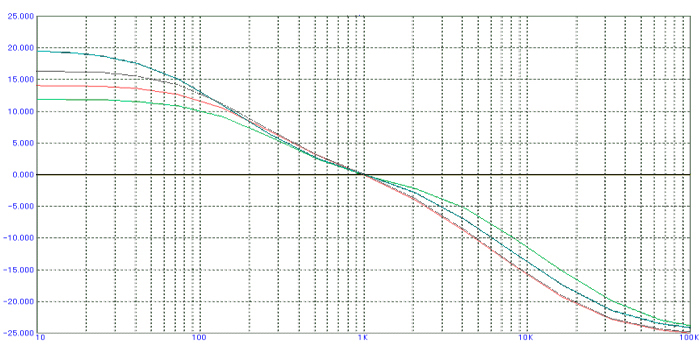
A phono preamp designed for historical curves allows the user to select from various pre-RIAA equalization settings. Instead of relying on a single filter network, it incorporates multiple combinations of time constants. These include curves associated with the labels and formats of that era—such as Columbia LP, Decca, EMI, NAB, and Victor—as well as other variants used prior to standardization.
An especially interesting aspect is that these curves do not differ solely in their high-frequency response. Some also alter the frequency at which bass boost begins—known as the “turnover” point—while others determine the degree of high-frequency attenuation during playback. Selecting the correct setting can completely transform the sonic presentation of a 78 rpm record or an early LP.
From a technical standpoint, a high-quality historical phono preamp should offer low noise, sufficient gain, and appropriate input impedance, but—above all—a precise equalization network. Ideally, the various curves should be selectable without introducing audible changes in signal level or adding coloration to the sound. This type of preamplifier is particularly useful for collectors of first editions, 78 rpm records, and LPs from the 1940s and early 1950s. Far more than a mere historical curiosity, restoring the original equalization allows for a much closer approximation of the recording medium’s intended sound.
The advent of the RIAA standard greatly simplified this landscape by establishing a common playback curve. However, for those listening to recordings made prior to its adoption, a preamplifier capable of reproducing those older equalization curves offers something a conventional RIAA preamp cannot: the ability to listen to each record using the specific curve for which it was designed.
No Comments